
When a hurricane is churning out in the Atlantic, the lines at the grocery store get long, the gas stations run dry, and—most importantly—insurance companies stop writing new policies.
If you wait until a storm has a name, you are officially too late.
Prepping your home with sandbags and plywood is only half the battle. If your paperwork isn’t airtight, a storm can wreck your finances just as easily as it wrecks your roof. Let’s walk through how to bulletproof your insurance coverage before the skies turn gray.
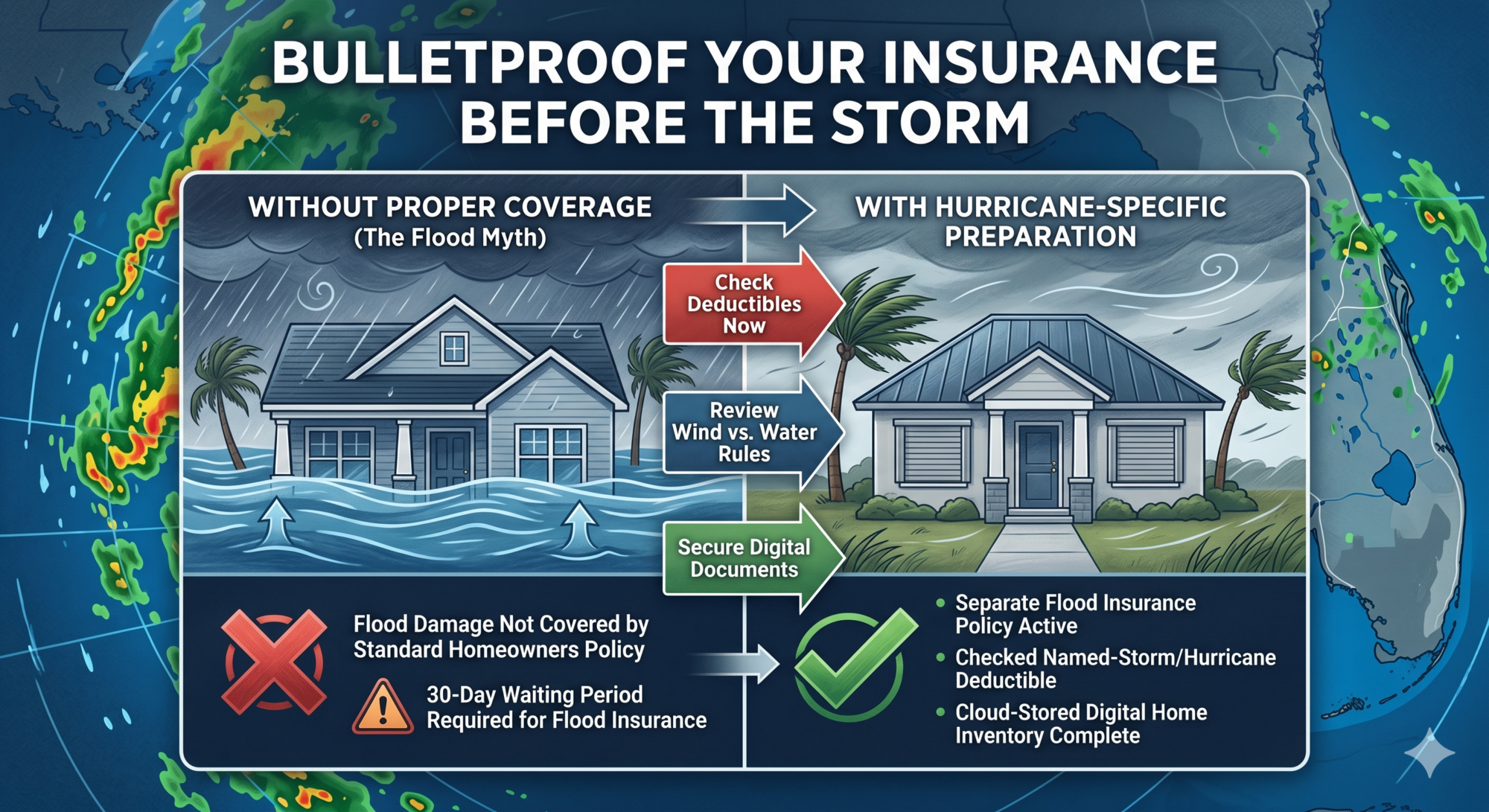
1. Look for the Big Gaps (The Flood Myth)
The single biggest mistake homeowners make is assuming “hurricane coverage” includes everything. It doesn’t.
-
The Standard Policy Loophole: Your standard homeowners policy covers wind and hail damage, but it almost never covers flood damage. If a storm surge pushes three feet of water into your living room, or heavy rain floods your neighborhood, a standard policy won’t pay a dime.
-
The 30-Day Rule: You need a separate flood insurance policy (usually through FEMA’s National Flood Insurance Program or a private market insurer). Crucially, flood insurance takes 30 days to go into effect. If you buy it the week a storm hits, it won’t apply.
The Wind vs. Water Rule: If a hurricane tears your roof off and rain pours in from above, that’s generally covered by your standard policy as wind damage. If water rises from the ground up into your home, that’s a flood, and it requires flood insurance.
2. Check Your “Named-Storm Deductible”
Most people are used to a flat deductible for standard claims—like a flat $$1,000$ out of pocket for a busted pipe. Hurricanes work differently.
If you live in a coastal state, your policy likely features a percentage deductible specifically for named storms or hurricanes. This is typically 2% to 5% of your home’s total insured value, not the cost of the damage.
For example, if your home is insured for $$400,000$ and you have a 5% hurricane deductible, you have to pay $$20,000$ out of pocket before your insurance coverage kicks in. Read your policy’s Declarations Page now so you aren’t blindsided by a massive bill when filing a claim.
3. Create a Digital “Home Inventory”
Trying to remember every single item in your closets, drawers, and garage after a disaster is nearly impossible. Insurance companies require proof of what you lost to pay out your contents coverage.
Do this today—it takes 10 minutes:
1.Take a video walkthrough:10 minutes.
Open every closet, drawer, and cabinet. Walk slowly through your home recording a video on your smartphone. Open appliances, look under beds, and point the camera at electronics.
2.Focus on big-ticket items:5 minutes.
Take individual, clear photos of serial numbers on TVs, computers, refrigerators, and major tools or appliances.
3.Gather major receipts:Optional but helpful.
Photograph receipts or dig up email confirmations for high-value items like jewelry, firearms, or expensive furniture.
4.Upload to the cloud:Immediate.
Do not leave this footage sitting solely on your phone. Upload it to Google Drive, iCloud, or Dropbox. If your phone gets water-damaged during the storm, your inventory stays perfectly safe.
4. Secure Your Documents
If you have to evacuate, you cannot rely on physical paperwork. Put together a digital “Go-Folder” on a secure cloud drive containing:
-
Your insurance policy declarations pages (with claim phone numbers)
-
Property deeds and vehicle titles
-
Color copies of IDs and birth certificates
If your home is completely uninhabitable, you will also want to look into your policy’s Loss of Use or Additional Living Expenses (ALE) coverage. This pays for hotel stays and restaurant meals while your home is being rebuilt—but you’ll need to save every single receipt to get reimbursed.